Rethinking the car-buying journey from search to delivery
ROLE
Product Designer

DURATION
10 Weeks
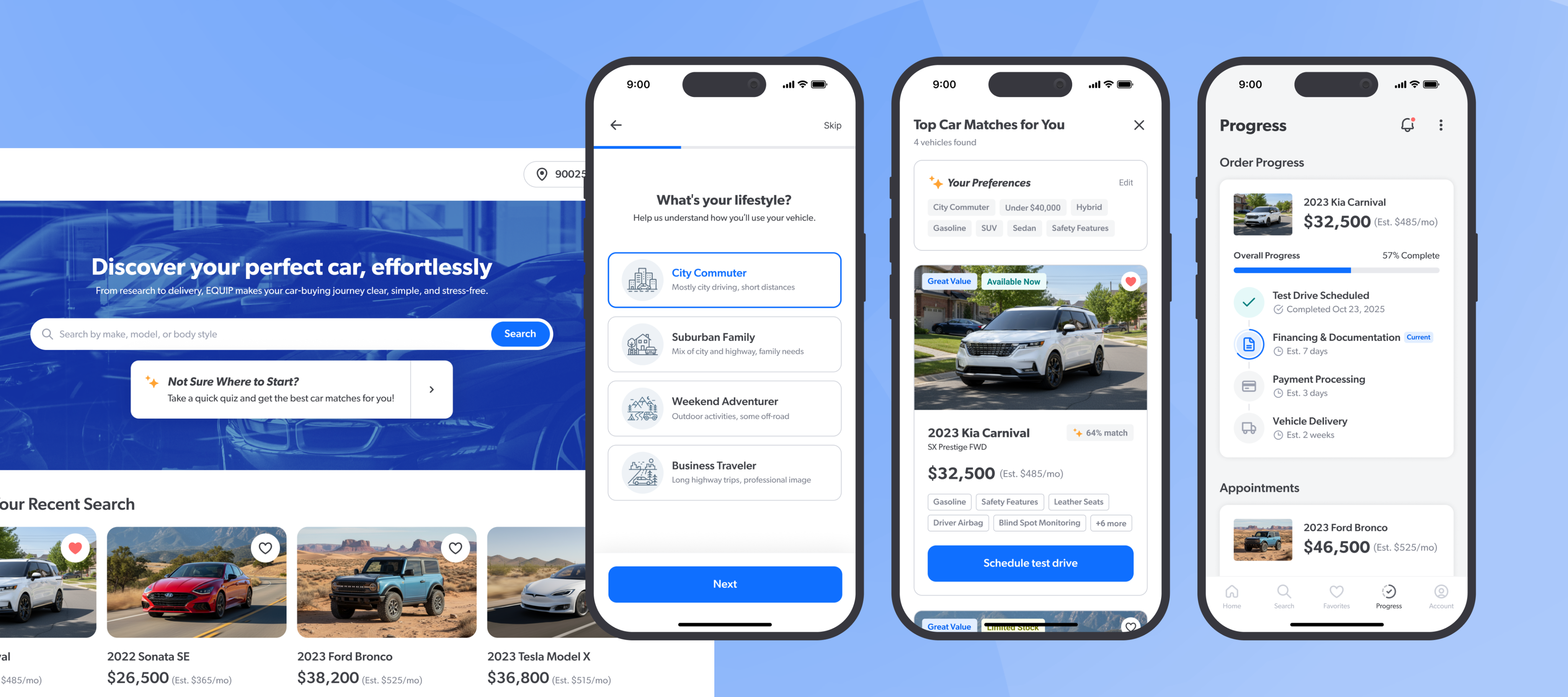
Bridging fragmented online and dealership experiences to give car buyers greater transparency, control, and confidence throughout the purchase journey
Overview
Equip is a 10-week conceptual project reimagining how people buy cars in a digital-first world. I conducted user research with 2 researchers, built a design system, and prototyped key features to bridge the gap between online search and offline dealership experiences in the car buying process.
Context
The pandemic accelerated the automotive industry's shift to digital, creating a critical demand for seamless online experiences. Buyers now expect transparency, efficiency, and personalization at every touchpoint, yet traditional car-buying processes remain fragmented.
Problem
Car buyers face friction at every step, including unclear pricing, complex paperwork, and inefficient dealership workflows. These pain points erode confidence and trust, highlighting an opportunity to create a transparent and efficient car-buying journey that empowers users to make informed, confident decisions.
Solution
We designed a streamlined, transparent car-buying experience that combines personalization and clarity at every step. Equip integrates a personalized onboarding quiz, advanced search, intuitive appointment management, and real-time progress tracking to help buyers feel in control from research to delivery.
Discover
Understanding Car Buyers Beyond the Dealership
The pandemic reshaped how people buy cars, accelerating the shift toward digital-first experiences. As expectations for online car shopping grew, traditional dealership processes struggled to keep pace. To design a car-buying experience that meets these evolving expectations, we began by understanding how people research, decide, and interact with dealerships today. We started by identifying what we didn’t know, then layered insights from market analysis, interviews, and real-world observation to uncover the gaps between buyer expectations and dealership realities.
Mapping What We Didn’t Know
Before conducting research, the two researchers and I mapped our assumptions through empathy mapping and an assumptions grid to identify where uncertainty could impact design decisions. This exercise revealed that while digital tools have simplified some aspects of car buying, the deeper pain points stem from lack of transparency, control, and personalization.
These low-certainty, high-risk assumptions guided our research questions around how buyers research vehicles, what shapes their trust, and how demographic or behavioral differences influence purchasing decisions.
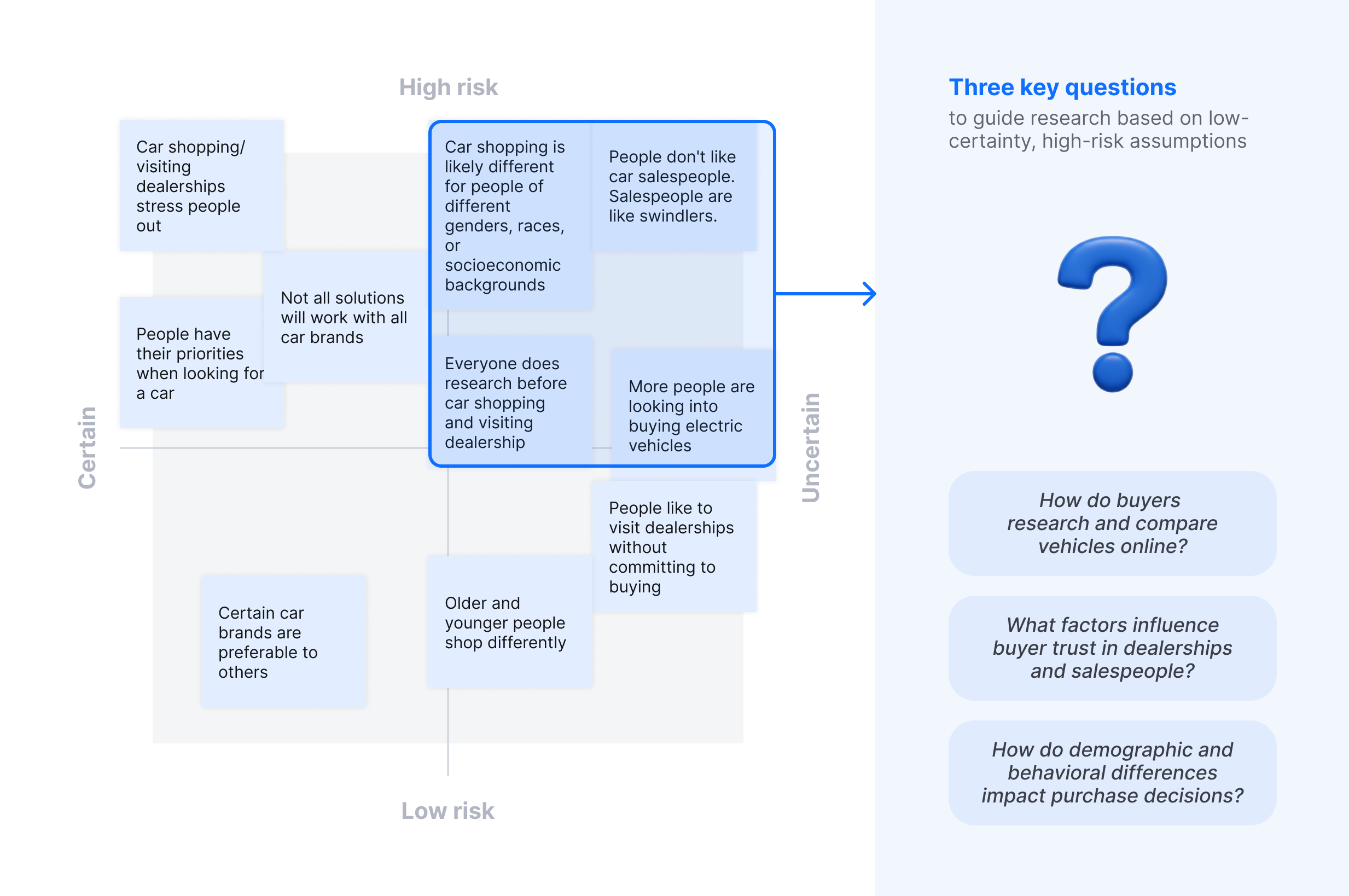
Assumption Grid and Key Research Questions
Spotting Friction in Today’s Online Car Shopping
To ground our research in current trends, we conducted secondary research and a heuristic review of major dealership websites. Reports from McKinsey, Deloitte, and Forbes confirmed that buyers research online but still seek in-person validation.
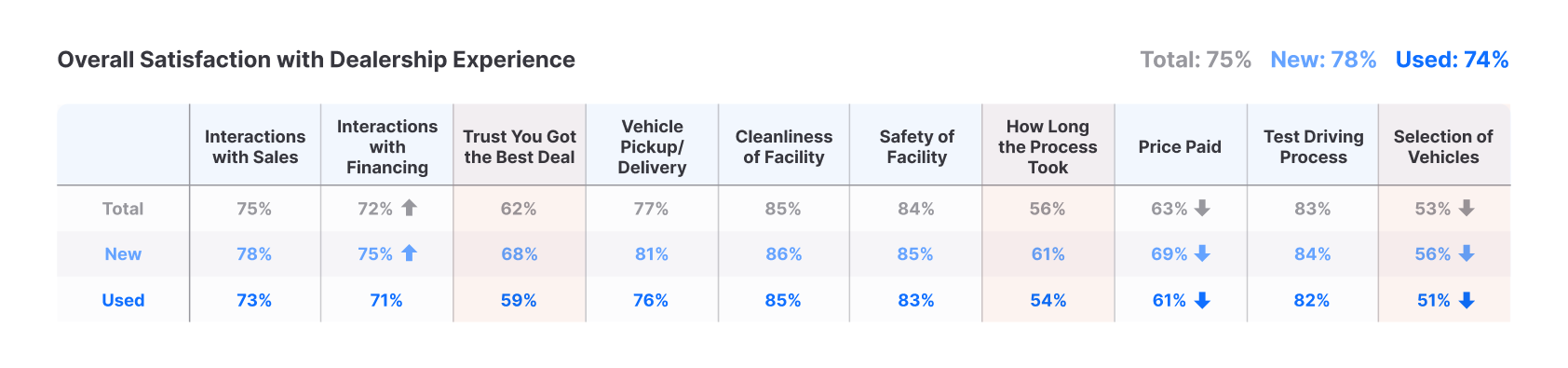
However, despite the rapid shift to digital, industry data revealed that satisfaction gains during the pandemic were short-lived. Buyers spent less time with dealerships, but their trust in pricing and process transparency remained low. Most dealership websites continued to lack clear pricing, accurate inventory, and transparent progress visibility, leaving buyers uncertain and frustrated.
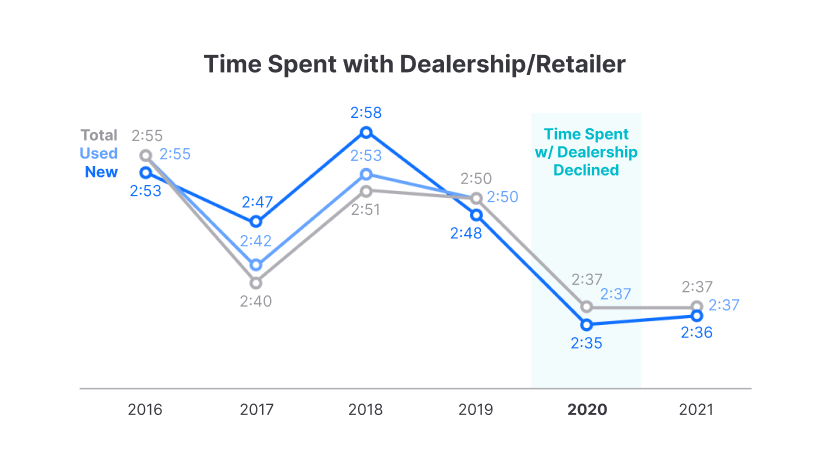
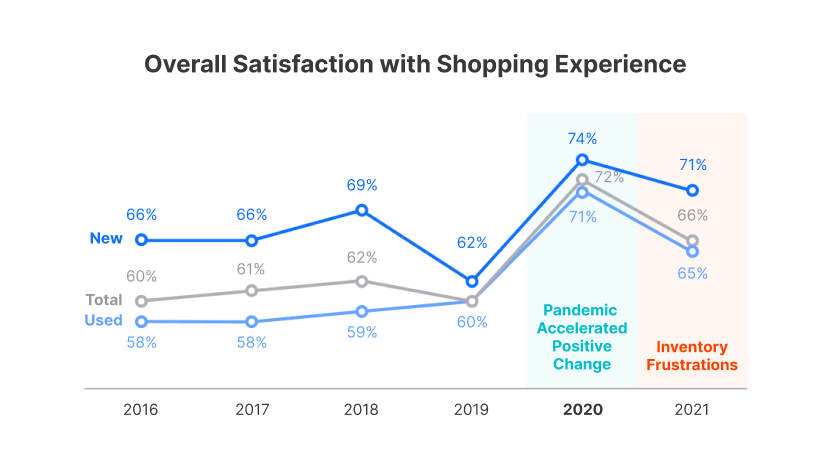
Source: Cox Automotive, 2021 Industry Trends Report
Uncovering the Trust Gap
We interviewed both car buyers and dealership stakeholders to capture a full perspective of the car-buying process. A set of interviews revealed a clear trust gap between buyers and dealerships. Buyers seek autonomy and clarity, while dealers rely on personal connection within constrained operations. This gap presents key design opportunitys.
User Interviews

Age Range: 27-46
Recent Car Buyers or Planning to Buy Soon
Car Buyers shared:
- The desire for clear, upfront pricing and personalized guidance.
- Spending significant time on research due to low trust in dealerships.
- Preferring streamlined services that minimize unnecessary steps.
Stakeholder Interviews
Age: 27 years old and 50 years old
Sales Representatives at Toyota and BMW
Dealership Stakeholders shared:
- Limited control over inventory and pricing due to rigid systems.
- Heavy reliance on personal relationships to maintain loyalty.
- The challenge of educating buyers who arrive with online preconceptions.
Watching Real Interactions to Reveal Hidden Friction
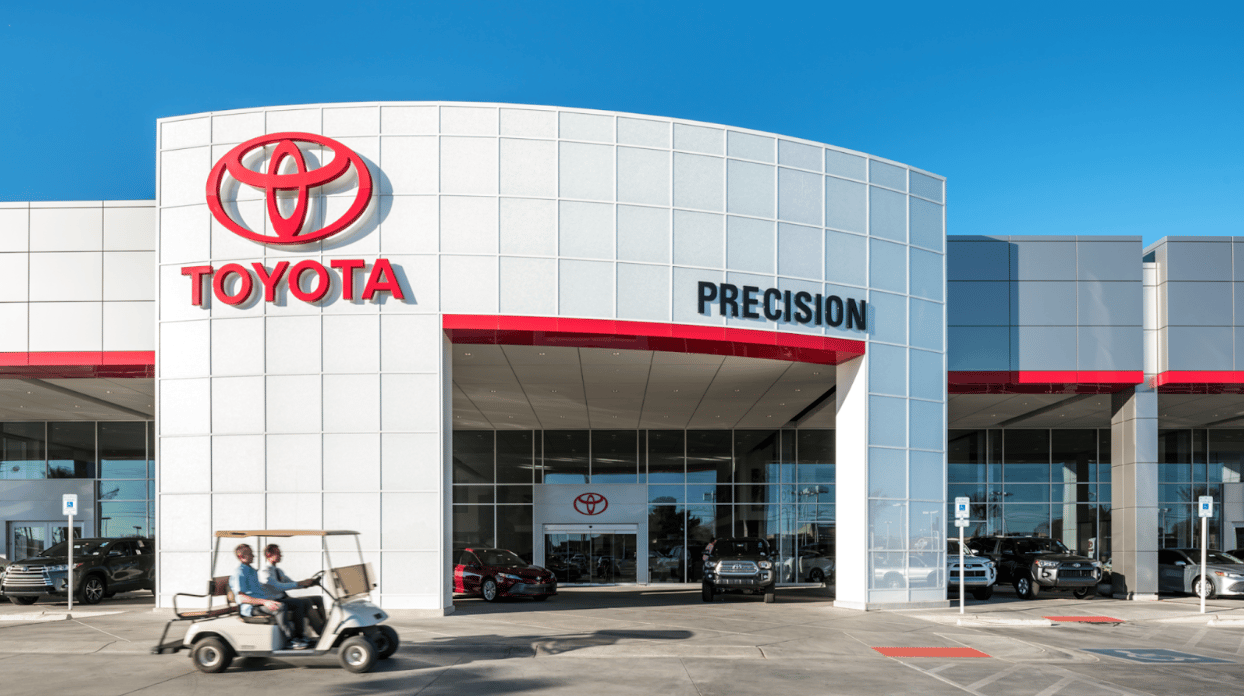
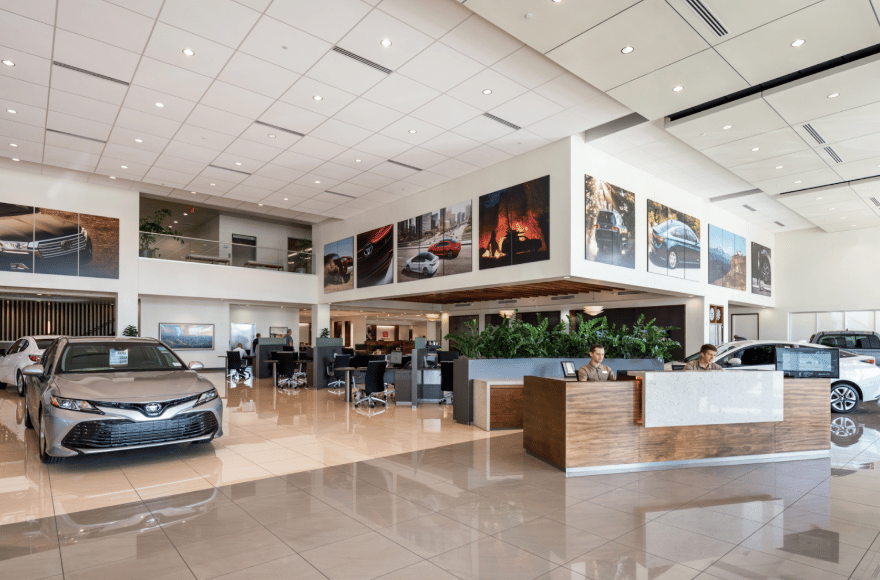
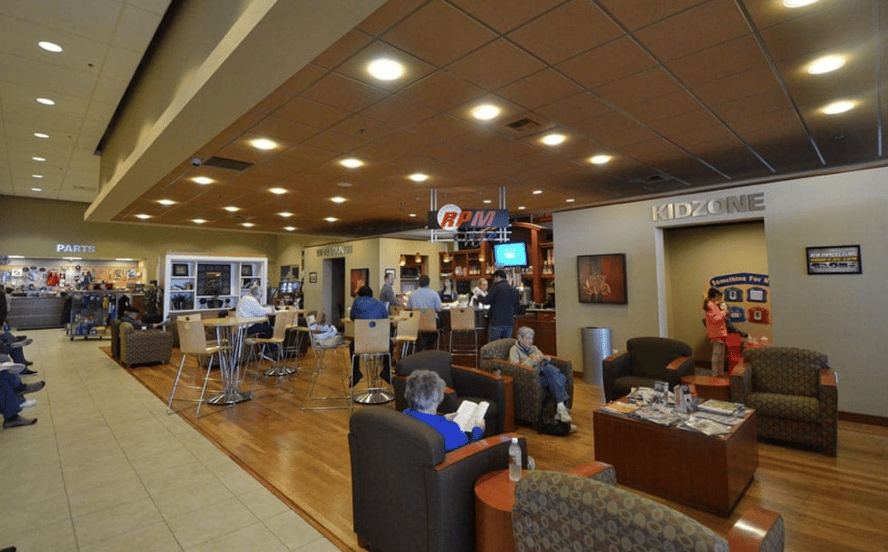
To contextualize these insights, we conducted a fly-on-the-wall observation at a Toyota dealership. Watching real interactions exposed friction that interviews alone couldn’t reveal. We observed:
- Inventory mismatch: Cars shown online were often unavailable in-store.
- Pricing reassurance: Buyers repeatedly sought confirmation about “no hidden fees.”
- Appointment efficiency: Scheduled visitors moved faster than walk-ins.
- Delivery opportunity: Many buyers expressed interest in home delivery options.
The key findings underscored the need for clarity, accuracy, and convenience. These helped us identify potential opportunities for accurate inventory management, transparent pricing, seamless appointment scheduling, and real-time progress monitoring.
Distilling Insights to Redefine the Journey
By triangulating insights from assumptions, secondary research, interviews, and observation, three consistent themes emerged: Transparency, Personalization, and Efficiency.
These findings reframed the car-buying experience not as a transaction, but as an emotional journey where trust and control drive confidence, laying the foundation for the Define phase.
Transparency
Buyers want clarity on pricing, inventory, and process.
Personalization
They expect tailored suggestions and experiences.
Efficiency
They value time-saving tools and predictable steps.
Define
Defining the Opportunity: Transparency, Personalization, and Control
After synthesizing research insights, we focused on translating pain points into a clear problem statement and a guiding “How Might We” question. This process established a shared understanding of the challenge and aligned our team around three guiding principles: personalization, transparency, and efficiency.
Problem Statement
Car buyers struggle with fragmented experiences, unclear pricing, and a lack of personalized guidance, leaving them uncertain and anxious about major purchase decisions. They need a transparent, efficient, and individually tailored process that helps them feel informed, in control, and confident in a car-buying journey.

How might we design a car-buying experience that empowers users with personalized guidance, transparent information, and seamless digital tools that build confidence, trust, and long-term satisfaction?
Forming Hypotheses to Guide Design Decisions
To translate our design principles into actionable directions, we defined three testable hypotheses. Each one focused on validating a key aspect of the car-buying experience: personalization, transparency, and efficiency. These hypotheses guided ideation and ensured that every concept we developed could be traced back to measurable user impact, building confidence, trust, and predictability throughout the journey.
#1: Personalization
We believe that guiding users through a personalized onboarding quiz will reduce decision fatigue and increase confidence in their car choices.
#2: Transparency
We believe that surfacing clear information about availability, pricing, and purchase progress will strengthen user trust throughout the buying journey.
#3: Efficiency
We believe that allowing users to manage appointments and complete key steps digitally will make the overall process more predictable and stress-free.
Ideate
Turning Root Causes Into Design Opportunities
With a clear problem definition in place, we moved into ideation. Our goal was not just to generate ideas, but to strategically uncover the highest-value opportunities that could reshape the car-buying experience. Using a combination of divergent and convergent methods, we explored root causes, broadened the solution space, and then converged on features that aligned with our design principles.
Why Buyers Feel Frustrated
To delve deeper into the reasons behind buyers’ challenges, we employed techniques such as the Five Whys, Storyboarding, and Journey Ideation. These methodologies revealed three root causes that shaped our direction: lack of transparency, personalization, and control. These findings served as the foundation for our design principles, ensuring that our solutions addressed the underlying systemic issues that contributed to buyer frustrations.
Lack of Transparency
in pricing, paperwork, and car-buying processes
Lack of Personalization
in buyer treatment and recommendations
Lack of Control
over timelines, availability, and outcomes
Three Underlying Issues
Clustering Ideas into Impact Areas
Next, we broadened the solution space through Crazy 8’s, Brainwriting, and Big Idea Vignettes. While the exercises produced dozens of individual ideas, patterns quickly emerged. We clustered them into six categories: Educational Resources, Customer Reviews, Comprehensive Research Tool, Personalized Buying Experience, Price and Financing Details, and Streamlined Purchasing Process. This clustering highlighted the breadth of opportunities available while helping us ensure no key pain point was overlooked.
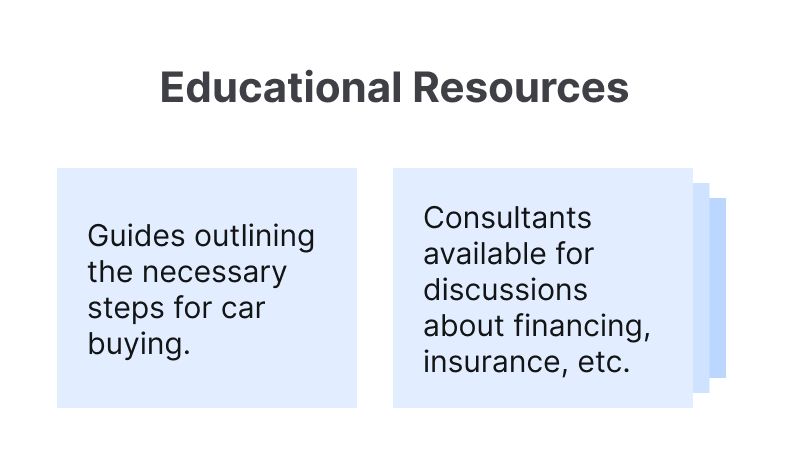
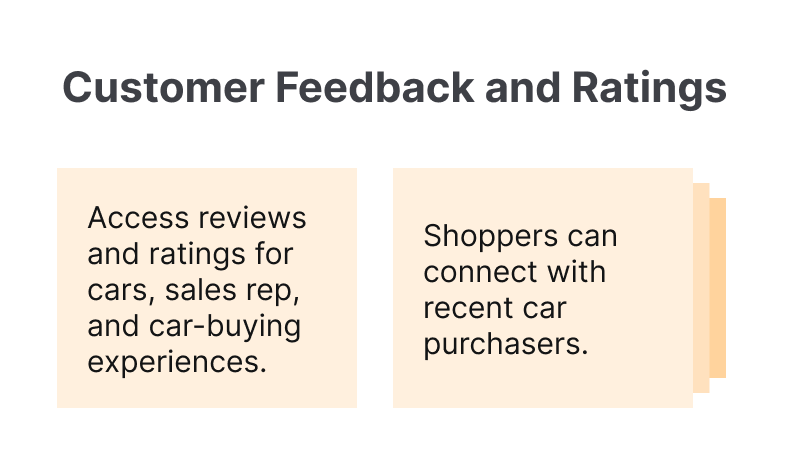
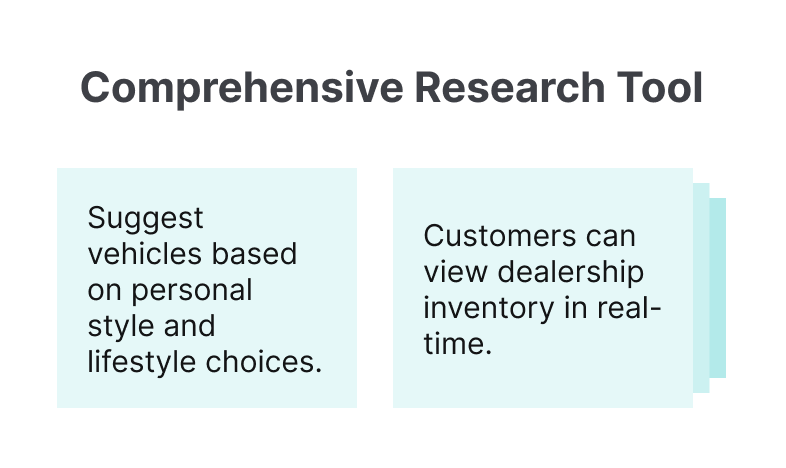
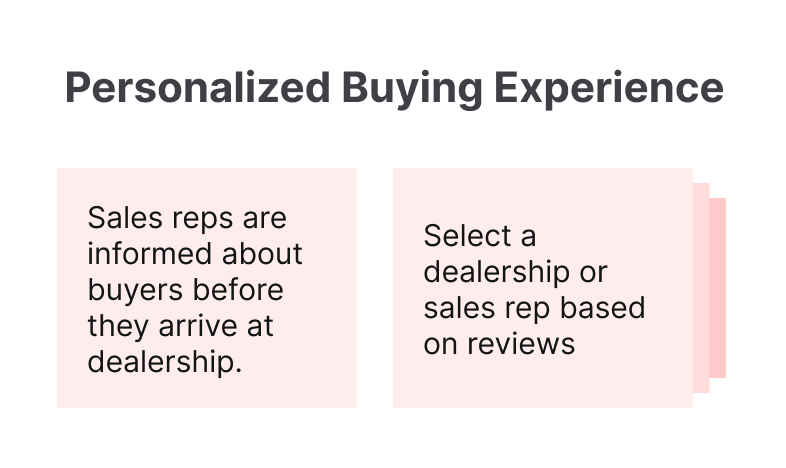
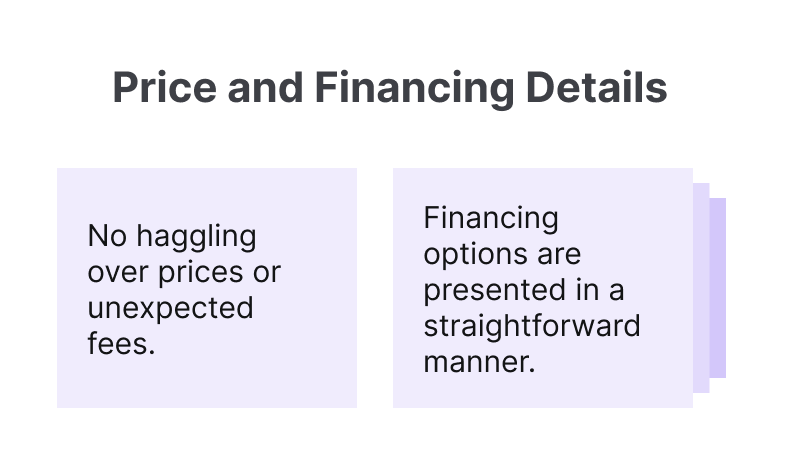
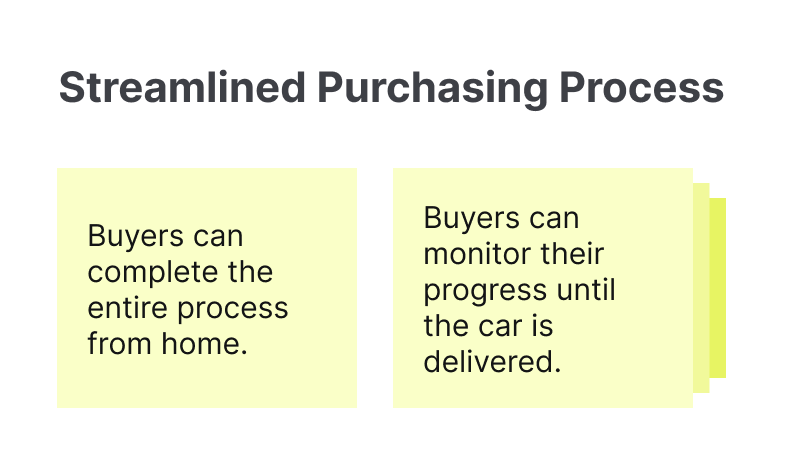
Six Categories from Big Idea Vignettes
Prioritizing Features to Test and Prototype
Through synthesis and prioritization with our Idea Portfolio, we converged on the six opportunities with the greatest potential impact:
- Personalization Quiz to recommend cars based on lifestyle and needs
- Advanced Search to empower research and build confidence
- Appointment Scheduling & Confirmation to streamline dealership interactions
- Progress Tracking to create transparency throughout the purchase
- Car Delivery & Handoff to improve convenience and satisfaction
- Post-Purchase Touchpoints to foster trust and long-term loyalty
These opportunities became the backbone of our prototypes, ensuring that our solutions address user frustrations throughout the entire car-buying journey, from research to post-purchase.
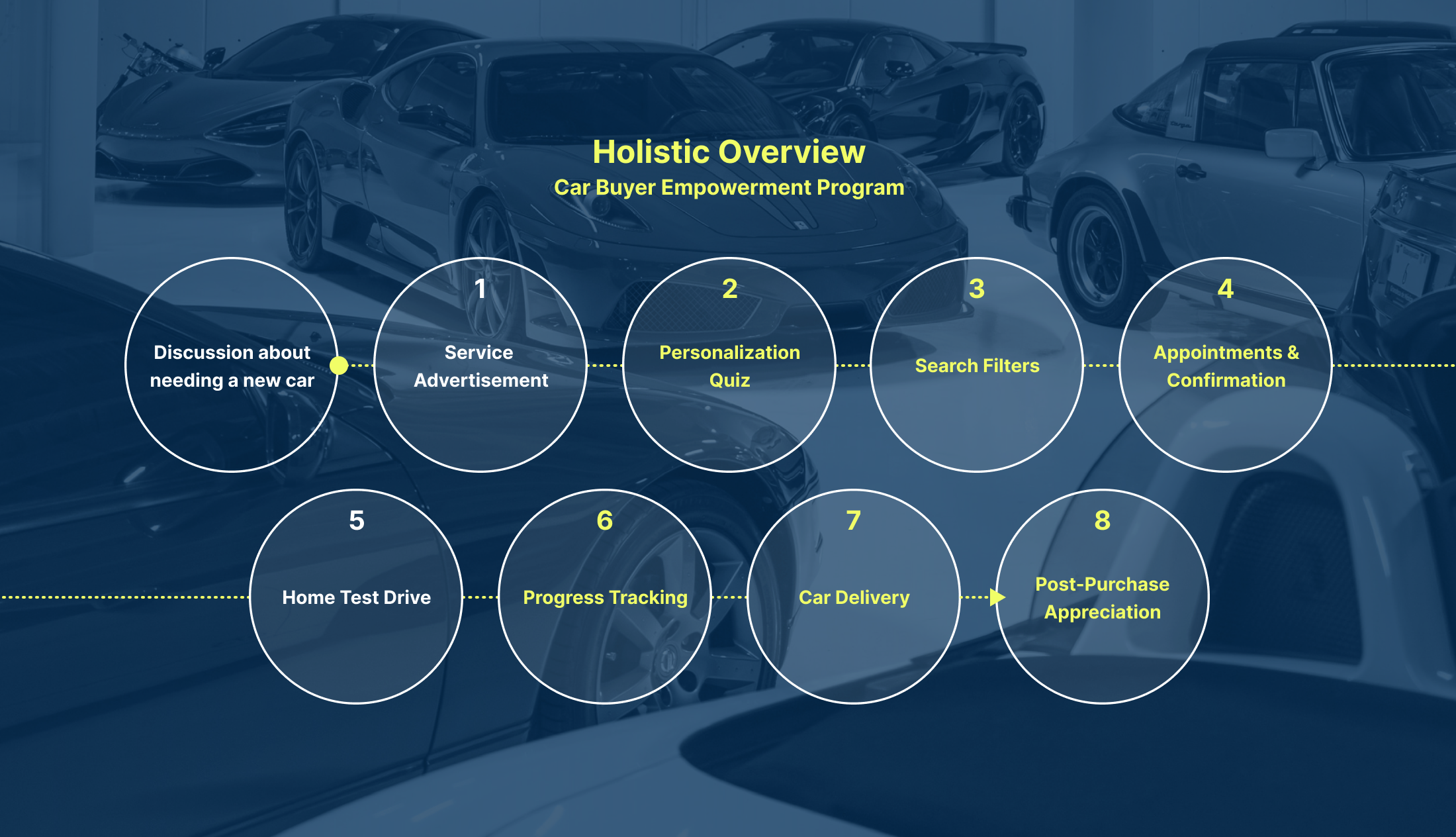
Holistic Overview of Revamped Car-Buying Journey
Prototype
Creating a Cohesive, Scalable Design System
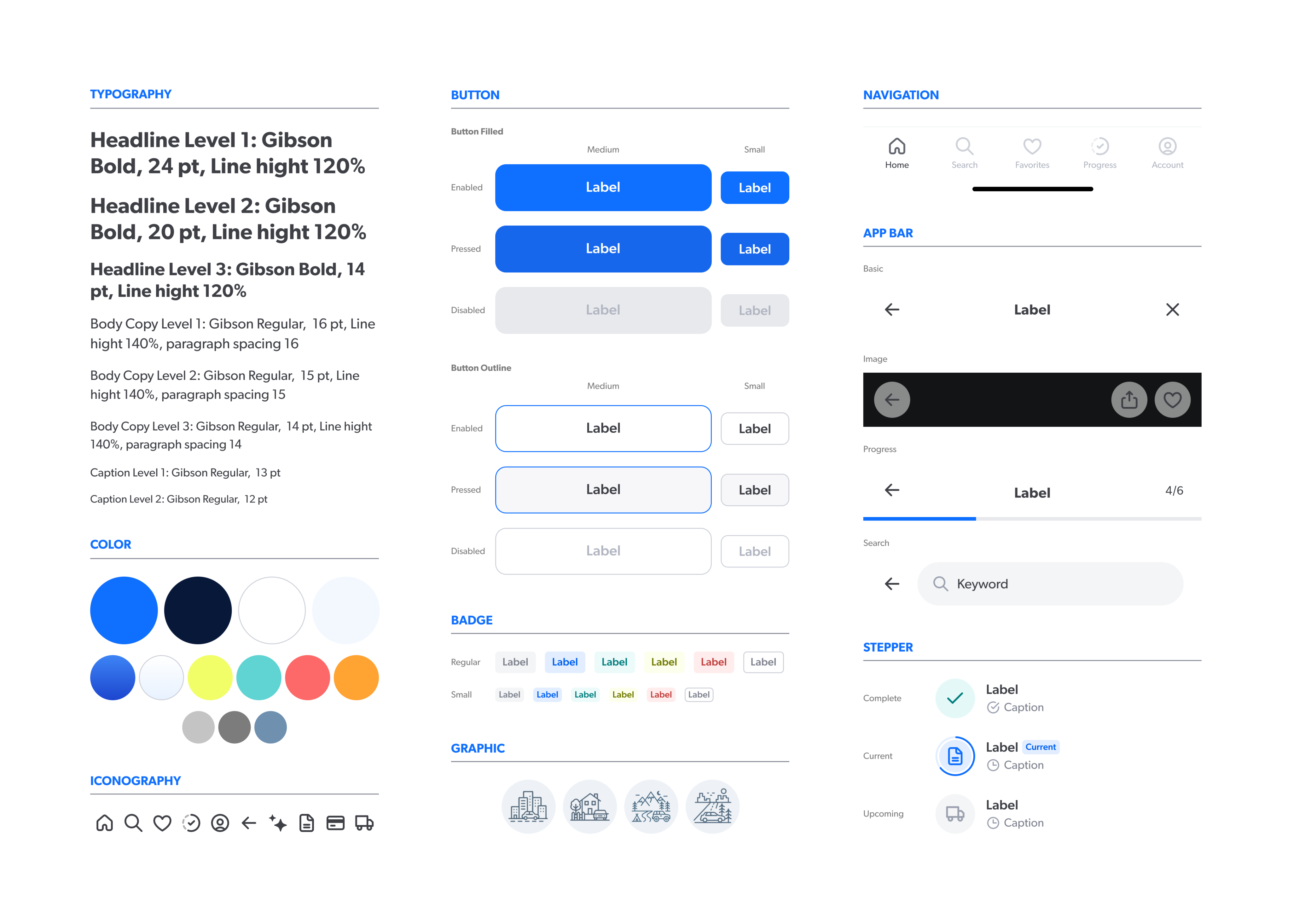
As I progressed from sketches to prototypes, I noticed that inconsistent visual hierarchy, spacing, and component use created friction. To address this, I developed a structured design system that defined typography, color, spacing, and reusable UI components. This system acted as a visual north star, ensuring consistency across screens while improving scalability and efficiency.
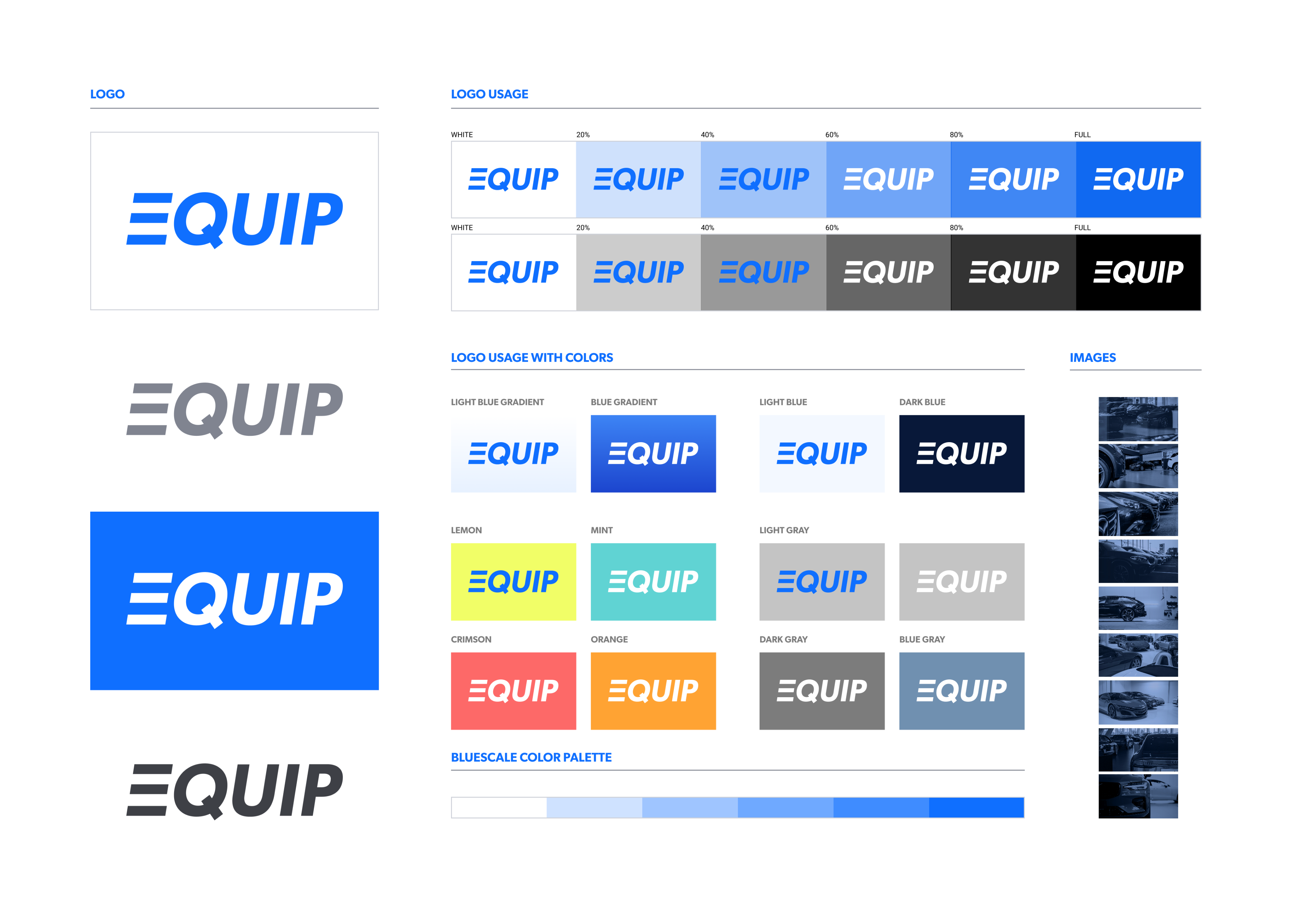
Improving the Experience through Reviews
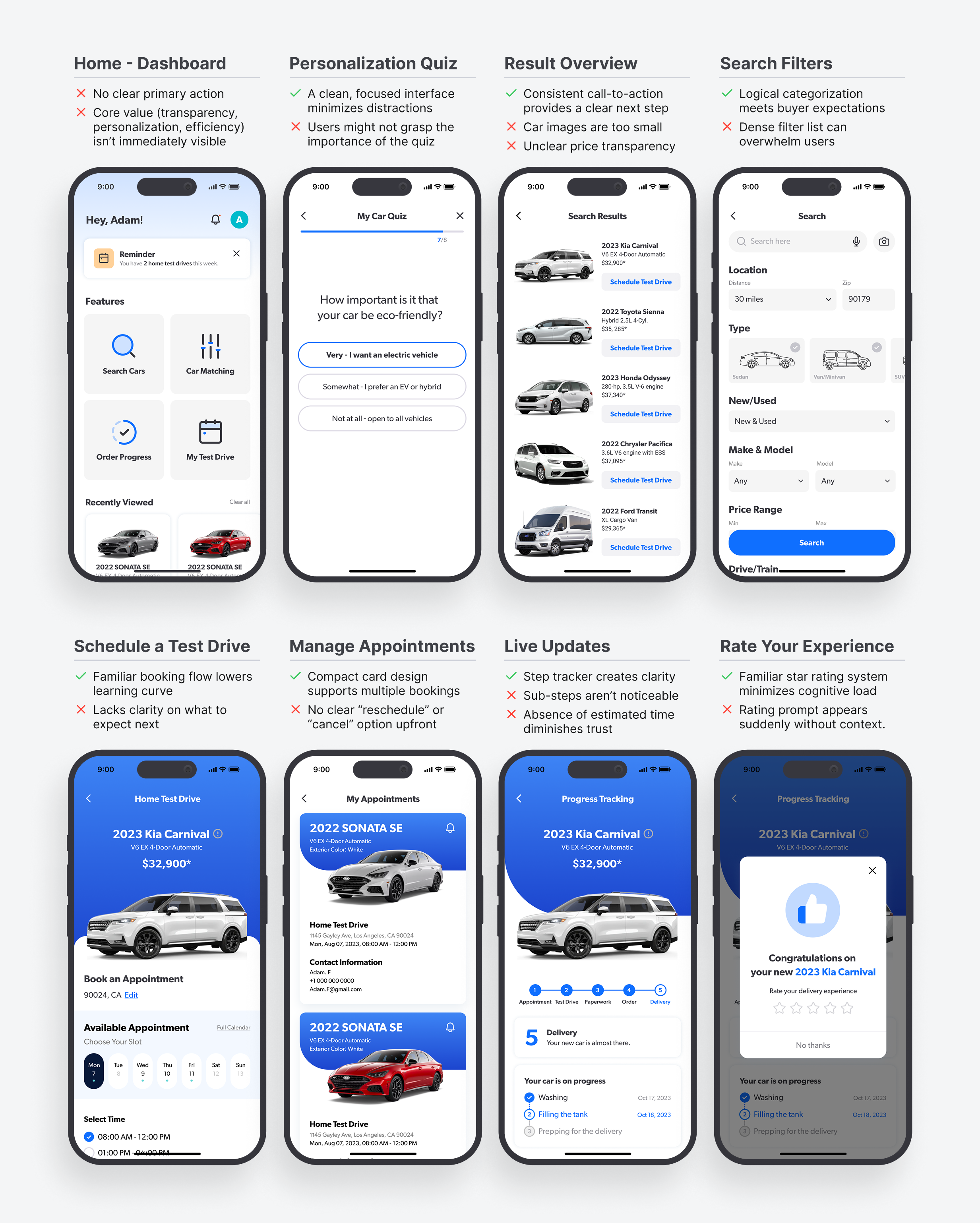
I developed initial prototypes utilizing the design system. To validate our prototypes before finalizing solutions, I conducted peer and heuristic reviews based on the design principles of personalization, transparency, and efficiency. These reviews identified overarching patterns across the user experience.
3 Key Learnings That Shaped Refinement
- Clear Hierarchy: Establishing a clear hierarchy fosters confidence
- Simplification: Reducing cognitive load supports decision-making
- Transparency: Surfacing key elements and details strengthens trust
By applying these learnings, I refined the core flows to become more intuitive, predictable, and trustworthy, ensuring that final solutions more closely align with both user expectations and our guiding principles.
Peer and Heuristic Reviews with Initial Prototypes
Deliver
Delivering a Personalized, Transparent, and Seamless Car-Buying Experience
Building on the insights from peer and heuristic reviews, I refined the details that most impacted buyer confidence. The final solution translates validated concepts into a highly personalized, transparent, and streamlined experience that addresses core buyer frustrations while aligning with dealership workflows.
Helping Users Choose with Confidence
To reduce decision fatigue, EQUIP begins with a guided personalization quiz that translates lifestyle needs into tailored car recommendations. The updated flow surfaces clear preferences, highlights top matches, and allows users to adjust criteria anytime from the home screen. By prioritizing hierarchy and simplicity, this feature helps buyers feel confident that they are seeing cars that truly fit their lives.
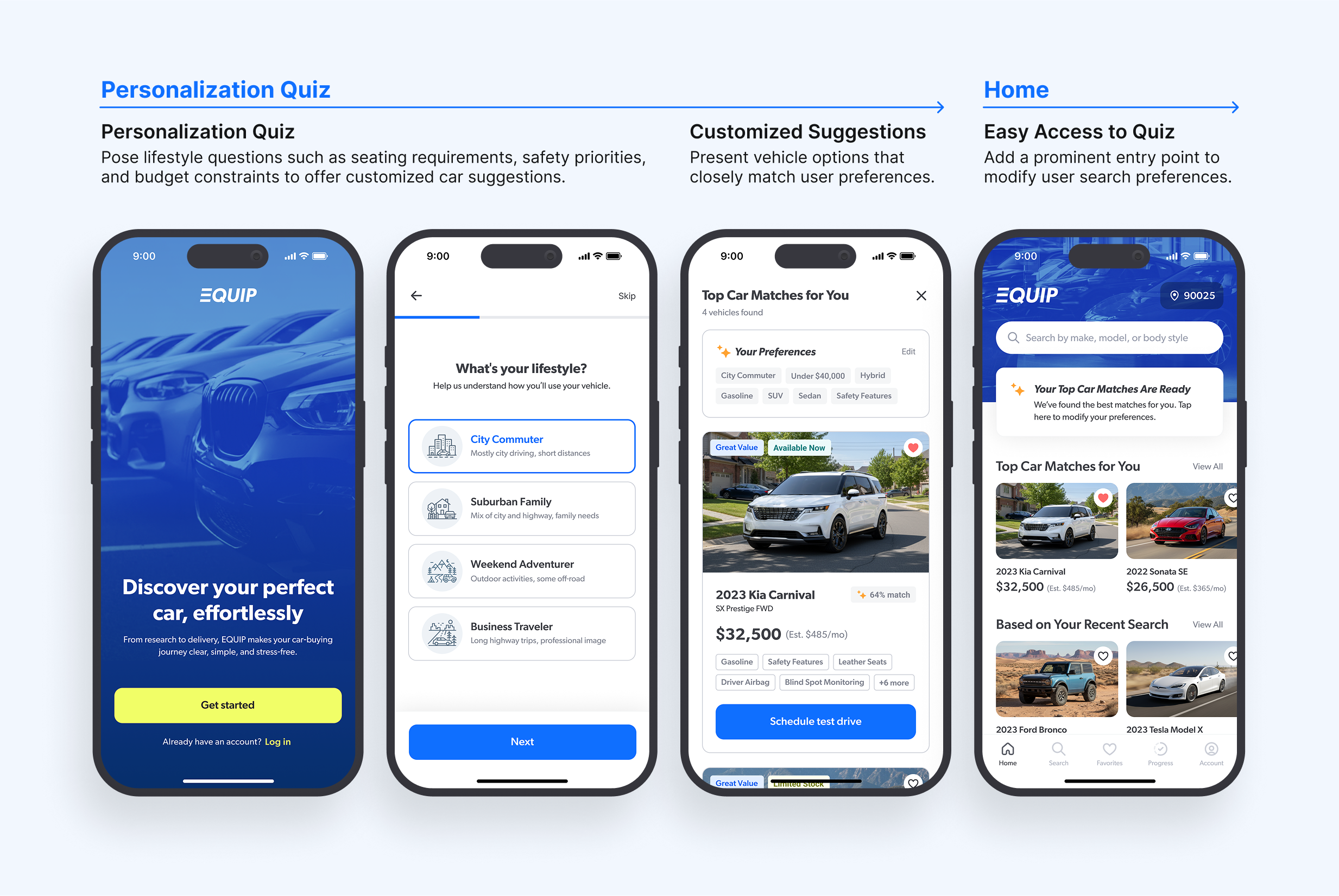
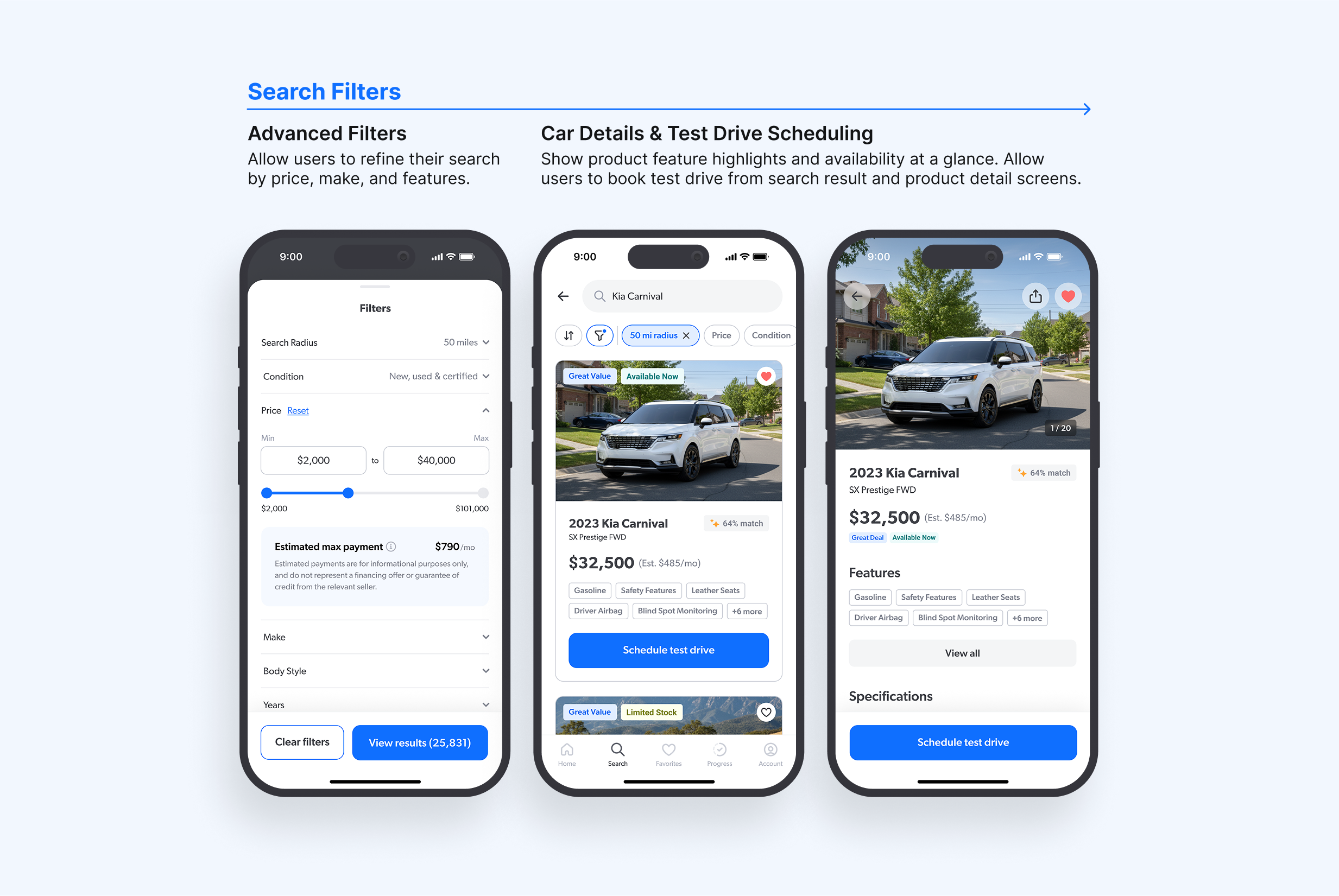
Making Search and Scheduling Seamless
Buyers can refine searches with advanced filters while keeping interactions simple and scannable. Car detail pages highlight key features, pricing, and availability at a glance, reinforcing trust through transparency. The integrated “Schedule Test Drive” action removes friction, enabling users to move smoothly from research to action in just a few clicks.
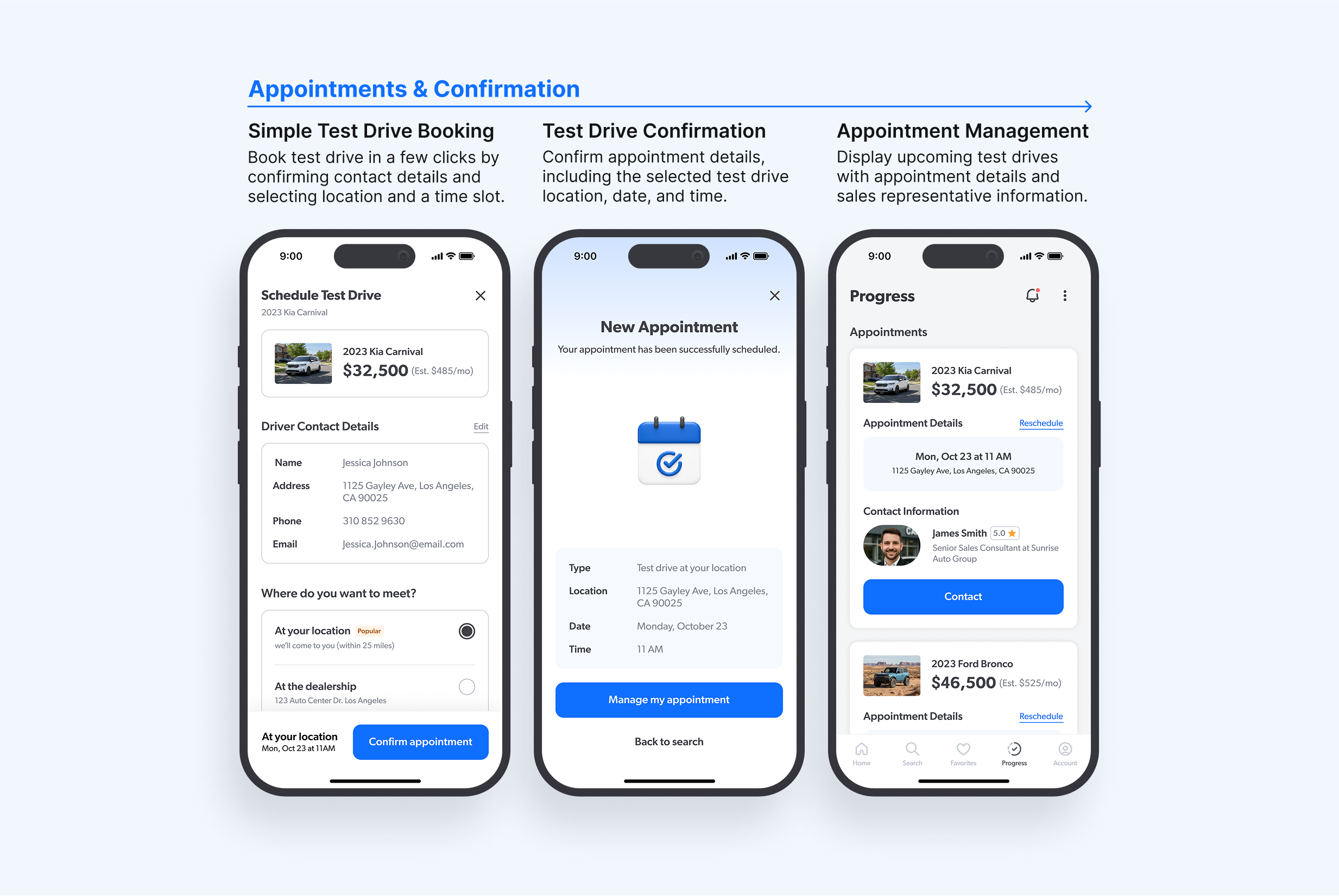
Simplifying Appointment Management
Scheduling a test drive is reduced to a few straightforward steps, supported by clear confirmation states and easily managed appointments. This flow eliminates the ambiguity often tied to dealership visits, ensuring buyers know exactly when, where, and how their test drives will happen. By surfacing details clearly, EQUIP strengthens trust and predictability in the car-buying process.
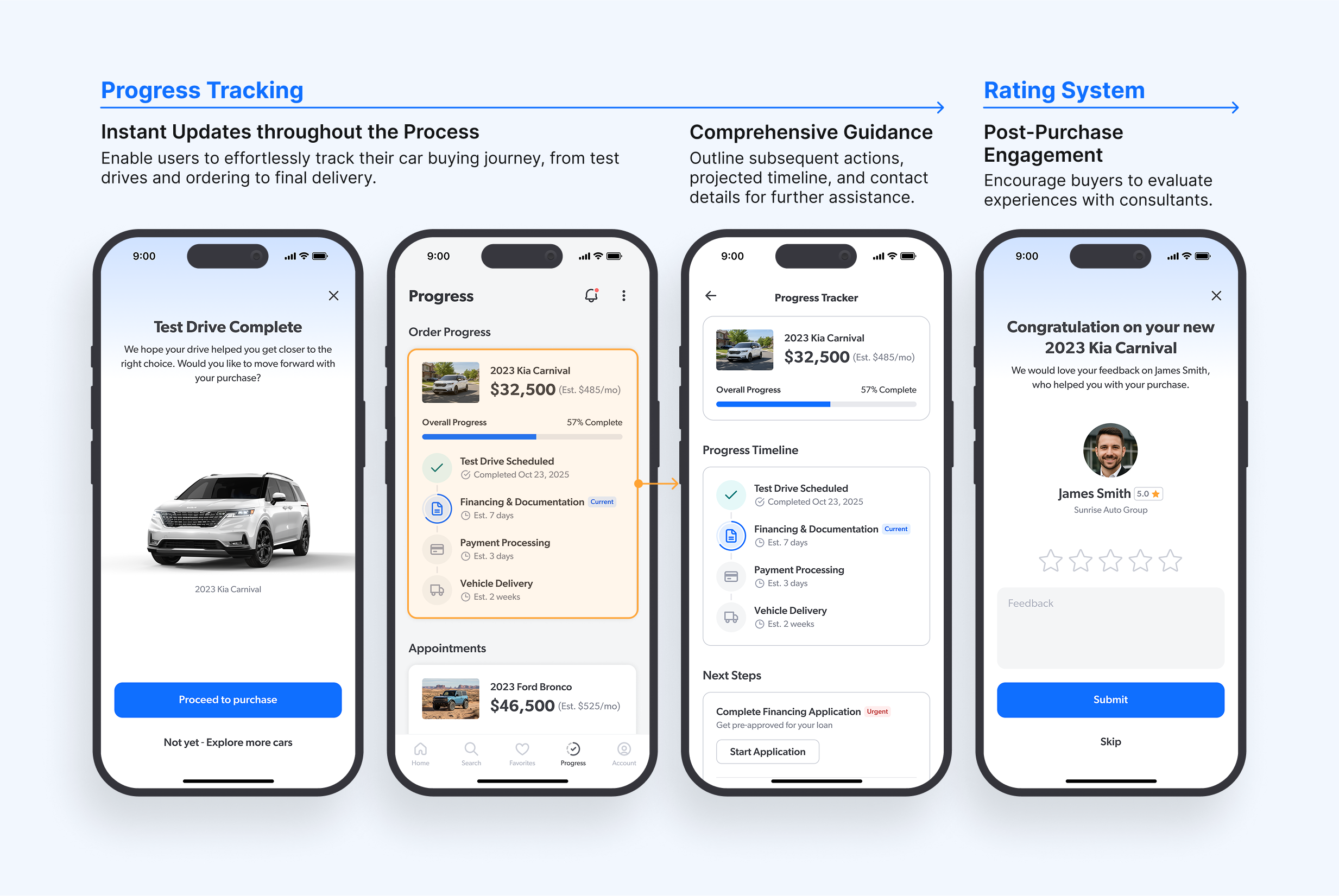
Adding Transparency and Post-Purchase Support
EQUIP keeps buyers informed with a transparent progress tracker, outlining each step from test drive to delivery. Sub-steps, timelines, and next actions are surfaced clearly, giving users a sense of control and reducing uncertainty. After purchase, the built-in rating system closes the loop by encouraging feedback and reinforcing accountability between buyers and dealerships.
Reflect
Lessons Learned and Opportunities
This project was an opportunity to redefine how digital solutions can enhance the traditional car-buying journey while preserving human interactions. By integrating research insights into the design process, we identified key digital interventions that reduce friction, build trust, and empower buyers. This case study highlights how thoughtful UX design can transform complex offline experiences into seamless digital interactions.
What Worked
Research-Driven, User-Centric Decision Making
Extensive user research was pivotal in deepening our understanding of the project. In-depth user and stakeholder interviews not only validated our assumptions but also guided us in refining solutions with precision. Collaborative insights from various views helped shape a holistic, well-informed design.
Areas to Improve
Balancing Team Diversity with Cohesive Design
Working with a multidisciplinary team brought valuable new perspectives. However, ensuring a unified design language across different contributors required careful iteration. This reinforced the importance of a structured design system to maintain visual and functional consistency.
Next Opportunity
Testing, Iterating, and Scaling
Next steps include user testing to validate and refine the design. Additionally, expanding the design for tablet and web platforms will enhance accessibility, while refining the brand guide will ensure a more scalable and cohesive user experience. Continuous improvements will further streamline the digital-to-physical transition in car buying.
Rethinking the car-buying journey from search to delivery
ROLE
Product Designer

DURATION
10 Weeks
Bridging fragmented online and dealership experiences to give car buyers greater transparency, control, and confidence throughout the purchase journey
Overview
Equip is a 10-week conceptual project reimagining how people buy cars in a digital-first world. I conducted user research with 2 researchers, built a design system, and prototyped key features to bridge the gap between online search and offline dealership experiences in the car buying process.
Context
The pandemic accelerated the automotive industry's shift to digital, creating a critical demand for seamless online experiences. Buyers now expect transparency, efficiency, and personalization at every touchpoint, yet traditional car-buying processes remain fragmented.
Problem
Car buyers face friction at every step, including unclear pricing, complex paperwork, and inefficient dealership workflows. These pain points erode confidence and trust, highlighting an opportunity to create a transparent and efficient car-buying journey that empowers users to make informed, confident decisions.
Solution
We designed a streamlined, transparent car-buying experience that combines personalization and clarity at every step. Equip integrates a personalized onboarding quiz, advanced search, intuitive appointment management, and real-time progress tracking to help buyers feel in control from research to delivery.
Discover
Understanding Car Buyers Beyond the Dealership
The pandemic reshaped how people buy cars, accelerating the shift toward digital-first experiences. As expectations for online car shopping grew, traditional dealership processes struggled to keep pace. To design a car-buying experience that meets these evolving expectations, we began by understanding how people research, decide, and interact with dealerships today. We started by identifying what we didn’t know, then layered insights from market analysis, interviews, and real-world observation to uncover the gaps between buyer expectations and dealership realities.
Mapping What We Didn’t Know
Before conducting research, the two researchers and I mapped our assumptions through empathy mapping and an assumptions grid to identify where uncertainty could impact design decisions. This exercise revealed that while digital tools have simplified some aspects of car buying, the deeper pain points stem from lack of transparency, control, and personalization.
These low-certainty, high-risk assumptions guided our research questions around how buyers research vehicles, what shapes their trust, and how demographic or behavioral differences influence purchasing decisions.
Assumption Grid and Key Research Questions
Spotting Friction in Today’s Online Car Shopping
To ground our research in current trends, we conducted secondary research and a heuristic review of major dealership websites. Reports from McKinsey, Deloitte, and Forbes confirmed that buyers research online but still seek in-person validation.
However, despite the rapid shift to digital, industry data revealed that satisfaction gains during the pandemic were short-lived. Buyers spent less time with dealerships, but their trust in pricing and process transparency remained low. Most dealership websites continued to lack clear pricing, accurate inventory, and transparent progress visibility, leaving buyers uncertain and frustrated.
Source: Cox Automotive, 2021 Industry Trends Report
Uncovering the Trust Gap
We interviewed both car buyers and dealership stakeholders to capture a full perspective of the car-buying process. A set of interviews revealed a clear trust gap between buyers and dealerships. Buyers seek autonomy and clarity, while dealers rely on personal connection within constrained operations. This gap presents key design opportunitys.
User Interviews

Age Range: 27-46
Recent Car Buyers or Planning to Buy Soon
Car Buyers shared:
- The desire for clear, upfront pricing and personalized guidance.
- Spending significant time on research due to low trust in dealerships.
- Preferring streamlined services that minimize unnecessary steps.
Stakeholder Interviews
Age: 27 years old and 50 years old
Sales Representatives at Toyota and BMW
Dealership Stakeholders shared:
- Limited control over inventory and pricing due to rigid systems.
- Heavy reliance on personal relationships to maintain loyalty.
- The challenge of educating buyers who arrive with online preconceptions.
Watching Real Interactions to Reveal Hidden Friction
To contextualize these insights, we conducted a fly-on-the-wall observation at a Toyota dealership. Watching real interactions exposed friction that interviews alone couldn’t reveal. We observed:
- Inventory mismatch: Cars shown online were often unavailable in-store.
- Pricing reassurance: Buyers repeatedly sought confirmation about “no hidden fees.”
- Appointment efficiency: Scheduled visitors moved faster than walk-ins.
- Delivery opportunity: Many buyers expressed interest in home delivery options.
The key findings underscored the need for clarity, accuracy, and convenience. These helped us identify potential opportunities for accurate inventory management, transparent pricing, seamless appointment scheduling, and real-time progress monitoring.
Distilling Insights to Redefine the Journey
By triangulating insights from assumptions, secondary research, interviews, and observation, three consistent themes emerged: Transparency, Personalization, and Efficiency.
These findings reframed the car-buying experience not as a transaction, but as an emotional journey where trust and control drive confidence, laying the foundation for the Define phase.
Transparency
Buyers want clarity on pricing, inventory, and process.
Personalization
They expect tailored suggestions and experiences.
Efficiency
They value time-saving tools and predictable steps.
Define
Defining the Opportunity: Transparency, Personalization, and Control
After synthesizing research insights, we focused on translating pain points into a clear problem statement and a guiding “How Might We” question. This process established a shared understanding of the challenge and aligned our team around three guiding principles: personalization, transparency, and efficiency.
Problem Statement
Car buyers struggle with fragmented experiences, unclear pricing, and a lack of personalized guidance, leaving them uncertain and anxious about major purchase decisions. They need a transparent, efficient, and individually tailored process that helps them feel informed, in control, and confident in a car-buying journey.
How might we design a car-buying experience that empowers users with personalized guidance, transparent information, and seamless digital tools that build confidence, trust, and long-term satisfaction?
Forming Hypotheses to Guide Design Decisions
To translate our design principles into actionable directions, we defined three testable hypotheses. Each one focused on validating a key aspect of the car-buying experience: personalization, transparency, and efficiency. These hypotheses guided ideation and ensured that every concept we developed could be traced back to measurable user impact, building confidence, trust, and predictability throughout the journey.
#1: Personalization
We believe that guiding users through a personalized onboarding quiz will reduce decision fatigue and increase confidence in their car choices.
#2: Transparency
We believe that surfacing clear information about availability, pricing, and purchase progress will strengthen user trust throughout the buying journey.
#3: Efficiency
We believe that allowing users to manage appointments and complete key steps digitally will make the overall process more predictable and stress-free.
Ideate
Turning Root Causes Into Design Opportunities
With a clear problem definition in place, we moved into ideation. Our goal was not just to generate ideas, but to strategically uncover the highest-value opportunities that could reshape the car-buying experience. Using a combination of divergent and convergent methods, we explored root causes, broadened the solution space, and then converged on features that aligned with our design principles.
Why Buyers Feel Frustrated
To delve deeper into the reasons behind buyers’ challenges, we employed techniques such as the Five Whys, Storyboarding, and Journey Ideation. These methodologies revealed three root causes that shaped our direction: lack of transparency, personalization, and control. These findings served as the foundation for our design principles, ensuring that our solutions addressed the underlying systemic issues that contributed to buyer frustrations.
Lack of Transparency
in pricing, paperwork, and car-buying processes
Lack of Personalization
in buyer treatment and recommendations
Lack of Control
over timelines, availability, and outcomes
Three Underlying Issues
Clustering Ideas into Impact Areas
Next, we broadened the solution space through Crazy 8’s, Brainwriting, and Big Idea Vignettes. While the exercises produced dozens of individual ideas, patterns quickly emerged. We clustered them into six categories: Educational Resources, Customer Reviews, Comprehensive Research Tool, Personalized Buying Experience, Price and Financing Details, and Streamlined Purchasing Process. This clustering highlighted the breadth of opportunities available while helping us ensure no key pain point was overlooked.
Six Categories from Big Idea Vignettes
Prioritizing Features to Test and Prototype
Through synthesis and prioritization with our Idea Portfolio, we converged on the six opportunities with the greatest potential impact:
- Personalization Quiz to recommend cars based on lifestyle and needs
- Advanced Search to empower research and build confidence
- Appointment Scheduling & Confirmation to streamline dealership interactions
- Progress Tracking to create transparency throughout the purchase
- Car Delivery & Handoff to improve convenience and satisfaction
- Post-Purchase Touchpoints to foster trust and long-term loyalty
These opportunities became the backbone of our prototypes, ensuring that our solutions address user frustrations throughout the entire car-buying journey, from research to post-purchase.
Holistic Overview of Revamped Car-Buying Journey
Prototype
Creating a Cohesive, Scalable Design System
As I progressed from sketches to prototypes, I noticed that inconsistent visual hierarchy, spacing, and component use created friction. To address this, I developed a structured design system that defined typography, color, spacing, and reusable UI components. This system acted as a visual north star, ensuring consistency across screens while improving scalability and efficiency.
Improving the Experience through Reviews
I developed initial prototypes utilizing the design system. To validate our prototypes before finalizing solutions, I conducted peer and heuristic reviews based on the design principles of personalization, transparency, and efficiency. These reviews identified overarching patterns across the user experience.
3 Key Learnings That Shaped Refinement
- Clear Hierarchy: Establishing a clear hierarchy fosters confidence
- Simplification: Reducing cognitive load supports decision-making
- Transparency: Surfacing key elements and details strengthens trust
By applying these learnings, I refined the core flows to become more intuitive, predictable, and trustworthy, ensuring that final solutions more closely align with both user expectations and our guiding principles.
Peer and Heuristic Reviews with Initial Prototypes
Deliver
Delivering a Personalized, Transparent, and Seamless Car-Buying Experience
Building on the insights from peer and heuristic reviews, I refined the details that most impacted buyer confidence. The final solution translates validated concepts into a highly personalized, transparent, and streamlined experience that addresses core buyer frustrations while aligning with dealership workflows.
Helping Users Choose with Confidence
To reduce decision fatigue, EQUIP begins with a guided personalization quiz that translates lifestyle needs into tailored car recommendations. The updated flow surfaces clear preferences, highlights top matches, and allows users to adjust criteria anytime from the home screen. By prioritizing hierarchy and simplicity, this feature helps buyers feel confident that they are seeing cars that truly fit their lives.
Making Search and Scheduling Seamless
Buyers can refine searches with advanced filters while keeping interactions simple and scannable. Car detail pages highlight key features, pricing, and availability at a glance, reinforcing trust through transparency. The integrated “Schedule Test Drive” action removes friction, enabling users to move smoothly from research to action in just a few clicks.
Simplifying Appointment Management
Scheduling a test drive is reduced to a few straightforward steps, supported by clear confirmation states and easily managed appointments. This flow eliminates the ambiguity often tied to dealership visits, ensuring buyers know exactly when, where, and how their test drives will happen. By surfacing details clearly, EQUIP strengthens trust and predictability in the car-buying process.
Adding Transparency and Post-Purchase Support
EQUIP keeps buyers informed with a transparent progress tracker, outlining each step from test drive to delivery. Sub-steps, timelines, and next actions are surfaced clearly, giving users a sense of control and reducing uncertainty. After purchase, the built-in rating system closes the loop by encouraging feedback and reinforcing accountability between buyers and dealerships.
Reflect
Lessons Learned and Opportunities
This project was an opportunity to redefine how digital solutions can enhance the traditional car-buying journey while preserving human interactions. By integrating research insights into the design process, we identified key digital interventions that reduce friction, build trust, and empower buyers. This case study highlights how thoughtful UX design can transform complex offline experiences into seamless digital interactions.
What Worked
Research-Driven, User-Centric Decision Making
Extensive user research was pivotal in deepening our understanding of the project. In-depth user and stakeholder interviews not only validated our assumptions but also guided us in refining solutions with precision. Collaborative insights from various views helped shape a holistic, well-informed design.
Areas to Improve
Balancing Team Diversity with Cohesive Design
Working with a multidisciplinary team brought valuable new perspectives. However, ensuring a unified design language across different contributors required careful iteration. This reinforced the importance of a structured design system to maintain visual and functional consistency.
Next Opportunity
Testing, Iterating, and Scaling
Next steps include user testing to validate and refine the design. Additionally, expanding the design for tablet and web platforms will enhance accessibility, while refining the brand guide will ensure a more scalable and cohesive user experience. Continuous improvements will further streamline the digital-to-physical transition in car buying.
Rethinking the car-buying journey from search to delivery
ROLE
Product Designer

DURATION
10 Weeks
Bridging fragmented online and dealership experiences to give car buyers greater transparency, control, and confidence throughout the purchase journey
Overview
Equip is a 10-week conceptual project reimagining how people buy cars in a digital-first world. I conducted user research with 2 researchers, built a design system, and prototyped key features to bridge the gap between online search and offline dealership experiences in the car buying process.
Context
The pandemic accelerated the automotive industry's shift to digital, creating a critical demand for seamless online experiences. Buyers now expect transparency, efficiency, and personalization at every touchpoint, yet traditional car-buying processes remain fragmented.
Problem
Car buyers face friction at every step, including unclear pricing, complex paperwork, and inefficient dealership workflows. These pain points erode confidence and trust, highlighting an opportunity to create a transparent and efficient car-buying journey that empowers users to make informed, confident decisions.
Solution
We designed a streamlined, transparent car-buying experience that combines personalization and clarity at every step. Equip integrates a personalized onboarding quiz, advanced search, intuitive appointment management, and real-time progress tracking to help buyers feel in control from research to delivery.
Discover
Understanding Car Buyers Beyond the Dealership
The pandemic reshaped how people buy cars, accelerating the shift toward digital-first experiences. As expectations for online car shopping grew, traditional dealership processes struggled to keep pace. To design a car-buying experience that meets these evolving expectations, we began by understanding how people research, decide, and interact with dealerships today. We started by identifying what we didn’t know, then layered insights from market analysis, interviews, and real-world observation to uncover the gaps between buyer expectations and dealership realities.
Mapping What We Didn’t Know
Before conducting research, the two researchers and I mapped our assumptions through empathy mapping and an assumptions grid to identify where uncertainty could impact design decisions. This exercise revealed that while digital tools have simplified some aspects of car buying, the deeper pain points stem from lack of transparency, control, and personalization.
These low-certainty, high-risk assumptions guided our research questions around how buyers research vehicles, what shapes their trust, and how demographic or behavioral differences influence purchasing decisions.
Assumption Grid and Key Research Questions
Spotting Friction in Today’s Online Car Shopping
To ground our research in current trends, we conducted secondary research and a heuristic review of major dealership websites. Reports from McKinsey, Deloitte, and Forbes confirmed that buyers research online but still seek in-person validation.
However, despite the rapid shift to digital, industry data revealed that satisfaction gains during the pandemic were short-lived. Buyers spent less time with dealerships, but their trust in pricing and process transparency remained low. Most dealership websites continued to lack clear pricing, accurate inventory, and transparent progress visibility, leaving buyers uncertain and frustrated.
Source: Cox Automotive, 2021 Industry Trends Report
Uncovering the Trust Gap
We interviewed both car buyers and dealership stakeholders to capture a full perspective of the car-buying process. A set of interviews revealed a clear trust gap between buyers and dealerships. Buyers seek autonomy and clarity, while dealers rely on personal connection within constrained operations. This gap presents key design opportunitys.
User Interviews
Age Range: 27-46
Recent Car Buyers or Planning to Buy Soon
Car Buyers shared:
- The desire for clear, upfront pricing and personalized guidance.
- Spending significant time on research due to low trust in dealerships.
- Preferring streamlined services that minimize unnecessary steps.
Stakeholder Interviews
Age: 27 years old and 50 years old
Sales Representatives at Toyota and BMW
Dealership Stakeholders shared:
- Limited control over inventory and pricing due to rigid systems.
- Heavy reliance on personal relationships to maintain loyalty.
- The challenge of educating buyers who arrive with online preconceptions.
Watching Real Interactions to Reveal Hidden Friction
To contextualize these insights, we conducted a fly-on-the-wall observation at a Toyota dealership. Watching real interactions exposed friction that interviews alone couldn’t reveal. We observed:
- Inventory mismatch: Cars shown online were often unavailable in-store.
- Pricing reassurance: Buyers repeatedly sought confirmation about “no hidden fees.”
- Appointment efficiency: Scheduled visitors moved faster than walk-ins.
- Delivery opportunity: Many buyers expressed interest in home delivery options.
The key findings underscored the need for clarity, accuracy, and convenience. These helped us identify potential opportunities for accurate inventory management, transparent pricing, seamless appointment scheduling, and real-time progress monitoring.
Distilling Insights to Redefine the Journey
By triangulating insights from assumptions, secondary research, interviews, and observation, three consistent themes emerged: Transparency, Personalization, and Efficiency.
These findings reframed the car-buying experience not as a transaction, but as an emotional journey where trust and control drive confidence, laying the foundation for the Define phase.
Transparency
Buyers want clarity on pricing, inventory, and process.
Personalization
They expect tailored suggestions and experiences.
Efficiency
They value time-saving tools and predictable steps.
Define
Defining the Opportunity: Transparency, Personalization, and Control
After synthesizing research insights, we focused on translating pain points into a clear problem statement and a guiding “How Might We” question. This process established a shared understanding of the challenge and aligned our team around three guiding principles: personalization, transparency, and efficiency.
Problem Statement
Car buyers struggle with fragmented experiences, unclear pricing, and a lack of personalized guidance, leaving them uncertain and anxious about major purchase decisions. They need a transparent, efficient, and individually tailored process that helps them feel informed, in control, and confident in a car-buying journey.
How might we design a car-buying experience that empowers users with personalized guidance, transparent information, and seamless digital tools that build confidence, trust, and long-term satisfaction?
Forming Hypotheses to Guide Design Decisions
To translate our design principles into actionable directions, we defined three testable hypotheses. Each one focused on validating a key aspect of the car-buying experience: personalization, transparency, and efficiency. These hypotheses guided ideation and ensured that every concept we developed could be traced back to measurable user impact, building confidence, trust, and predictability throughout the journey.
#1: Personalization
We believe that guiding users through a personalized onboarding quiz will reduce decision fatigue and increase confidence in their car choices.
#2: Transparency
We believe that surfacing clear information about availability, pricing, and purchase progress will strengthen user trust throughout the buying journey.
#3: Efficiency
We believe that allowing users to manage appointments and complete key steps digitally will make the overall process more predictable and stress-free.
Ideate
Turning Root Causes Into Design Opportunities
With a clear problem definition in place, we moved into ideation. Our goal was not just to generate ideas, but to strategically uncover the highest-value opportunities that could reshape the car-buying experience. Using a combination of divergent and convergent methods, we explored root causes, broadened the solution space, and then converged on features that aligned with our design principles.
Why Buyers Feel Frustrated
To delve deeper into the reasons behind buyers’ challenges, we employed techniques such as the Five Whys, Storyboarding, and Journey Ideation. These methodologies revealed three root causes that shaped our direction: lack of transparency, personalization, and control. These findings served as the foundation for our design principles, ensuring that our solutions addressed the underlying systemic issues that contributed to buyer frustrations.
Lack of Transparency
in pricing, paperwork, and car-buying processes
Lack of Personalization
in buyer treatment and recommendations
Lack of Control
over timelines, availability, and outcomes
Three Underlying Issues
Clustering Ideas into Impact Areas
Next, we broadened the solution space through Crazy 8’s, Brainwriting, and Big Idea Vignettes. While the exercises produced dozens of individual ideas, patterns quickly emerged. We clustered them into six categories: Educational Resources, Customer Reviews, Comprehensive Research Tool, Personalized Buying Experience, Price and Financing Details, and Streamlined Purchasing Process. This clustering highlighted the breadth of opportunities available while helping us ensure no key pain point was overlooked.
Six Categories from Big Idea Vignettes
Prioritizing Features to Test and Prototype
Through synthesis and prioritization with our Idea Portfolio, we converged on the six opportunities with the greatest potential impact:
- Personalization Quiz to recommend cars based on lifestyle and needs
- Advanced Search to empower research and build confidence
- Appointment Scheduling & Confirmation to streamline dealership interactions
- Progress Tracking to create transparency throughout the purchase
- Car Delivery & Handoff to improve convenience and satisfaction
- Post-Purchase Touchpoints to foster trust and long-term loyalty
These opportunities became the backbone of our prototypes, ensuring that our solutions address user frustrations throughout the entire car-buying journey, from research to post-purchase.
Holistic Overview of Revamped Car-Buying Journey
Prototype
Creating a Cohesive, Scalable Design System
As I progressed from sketches to prototypes, I noticed that inconsistent visual hierarchy, spacing, and component use created friction. To address this, I developed a structured design system that defined typography, color, spacing, and reusable UI components. This system acted as a visual north star, ensuring consistency across screens while improving scalability and efficiency.
Improving the Experience through Reviews
I developed initial prototypes utilizing the design system. To validate our prototypes before finalizing solutions, I conducted peer and heuristic reviews based on the design principles of personalization, transparency, and efficiency. These reviews identified overarching patterns across the user experience.
3 Key Learnings That Shaped Refinement
- Clear Hierarchy: Establishing a clear hierarchy fosters confidence
- Simplification: Reducing cognitive load supports decision-making
- Transparency: Surfacing key elements and details strengthens trust
By applying these learnings, I refined the core flows to become more intuitive, predictable, and trustworthy, ensuring that final solutions more closely align with both user expectations and our guiding principles.
Peer and Heuristic Reviews with Initial Prototypes
Deliver
Delivering a Personalized, Transparent, and Seamless Car-Buying Experience
Building on the insights from peer and heuristic reviews, I refined the details that most impacted buyer confidence. The final solution translates validated concepts into a highly personalized, transparent, and streamlined experience that addresses core buyer frustrations while aligning with dealership workflows.
Helping Users Choose with Confidence
To reduce decision fatigue, EQUIP begins with a guided personalization quiz that translates lifestyle needs into tailored car recommendations. The updated flow surfaces clear preferences, highlights top matches, and allows users to adjust criteria anytime from the home screen. By prioritizing hierarchy and simplicity, this feature helps buyers feel confident that they are seeing cars that truly fit their lives.
Making Search and Scheduling Seamless
Buyers can refine searches with advanced filters while keeping interactions simple and scannable. Car detail pages highlight key features, pricing, and availability at a glance, reinforcing trust through transparency. The integrated “Schedule Test Drive” action removes friction, enabling users to move smoothly from research to action in just a few clicks.
Simplifying Appointment Management
Scheduling a test drive is reduced to a few straightforward steps, supported by clear confirmation states and easily managed appointments. This flow eliminates the ambiguity often tied to dealership visits, ensuring buyers know exactly when, where, and how their test drives will happen. By surfacing details clearly, EQUIP strengthens trust and predictability in the car-buying process.
Adding Transparency and Post-Purchase Support
EQUIP keeps buyers informed with a transparent progress tracker, outlining each step from test drive to delivery. Sub-steps, timelines, and next actions are surfaced clearly, giving users a sense of control and reducing uncertainty. After purchase, the built-in rating system closes the loop by encouraging feedback and reinforcing accountability between buyers and dealerships.
Reflect
Lessons Learned and Opportunities
This project was an opportunity to redefine how digital solutions can enhance the traditional car-buying journey while preserving human interactions. By integrating research insights into the design process, we identified key digital interventions that reduce friction, build trust, and empower buyers. This case study highlights how thoughtful UX design can transform complex offline experiences into seamless digital interactions.
What Worked
Research-Driven, User-Centric Decision Making
Extensive user research was pivotal in deepening our understanding of the project. In-depth user and stakeholder interviews not only validated our assumptions but also guided us in refining solutions with precision. Collaborative insights from various views helped shape a holistic, well-informed design.
Areas to Improve
Balancing Team Diversity with Cohesive Design
Working with a multidisciplinary team brought valuable new perspectives. However, ensuring a unified design language across different contributors required careful iteration. This reinforced the importance of a structured design system to maintain visual and functional consistency.
Next Opportunity
Testing, Iterating, and Scaling
Next steps include user testing to validate and refine the design. Additionally, expanding the design for tablet and web platforms will enhance accessibility, while refining the brand guide will ensure a more scalable and cohesive user experience. Continuous improvements will further streamline the digital-to-physical transition in car buying.